TSAB Newsletter – September 2026

Spotlight Special

TSAB Logo with the text A spotlight on Identifying and reporting Safeguarding Concerns

Welcome to all of our new subscribers, and thank you for your interest in being a part of our Teeswide safeguarding community.

Please circulate the information in this newsletter within your organisation to help us to continue to raise awareness of Safeguarding Adults across Tees.

This week is TSAB’s Spotlight Campaign –

What is Safeguarding?

Safeguarding is – protecting an adult’s right to live in safety, free from abuse and neglect. It is about people and organisations working together to prevent and stop both the risks and experience of abuse or neglect, while at the same time making sure that the adult’s wellbeing is promoted including, where appropriate, having regard to their views, wishes, feelings and beliefs in deciding on any action. 

The Care Act safeguarding duty applies where there is reasonable cause to suspect that an adult:​

  • has needs for care and support (whether or not the authority is meeting any of those needs),
  • is experiencing, or is at risk of, abuse or neglect, and
  • as a result of those needs is unable to protect themselves against the abuse or neglect or the risk of it.

View and share TSAB’s Animation: What is Safeguarding? (BSL) – YouTube

View and share TSAB’s Webpage: What is Safeguarding? | Teeswide Safeguarding Adults Board

Recognising the Signs

Abuse can happen to anyone, anywhere. Recognising the signs is the first step to helping keep adults safe.

View and Share TSAB’s *NEW* Animation. Did you know TSAB has a whole suite of Safeguarding Animations?

Share TSAB’s Easy Read Guide with members of your community to support individuals with understanding safeguarding and the different types of abuse.

Learning Briefings are a quick and simple way to keep up to date on safeguarding topics.

When should you raise a Safeguarding Concern?

If you have concerns that an adult with care and support needs is at risk of, or is experiencing abuse or neglect, the following documents should be used to help you to follow the correct pathway. In an emergency always dial 999.

More information can be found on the Report Abuse webpage.

How to Raise a Concern

To report a concern for an adult living in Hartlepool, Stockton or Redcar you will need to complete the TSAB Concern Form. This has been recently reviewed, so make sure you are using the most up-to-date version!

If you are reporting concerns for an adult in Middlesbrough, you should use the Council’s online Adult Social Care portal.

If you would like guidance on how to complete a Concern Form, please see the Concern Form training examples

See Something, Say Something

When safeguarding concerns arise, remember to Think Family.

Consider whether there may be risks to others, including children or other adults with care and support needs.

If you believe a child may be at risk of harm, contact your local authority Children’s Services.

If you are concerned for an adult, contact your local authority Adult Social Care Team.

TSAB’s Think Family Guidance aims to prompt practitioners to think outside their immediate area of work group; to work across the ages and across services.

The new Decision Support Guidance (DSG) has been developed to support professionals, partners and providers across Teesside to make informed decisions about whether concerns relating to an adult with care and support needs should be raised with the Local Authority as a safeguarding concern.

The new guidance:

✅ Supports consistent decision-making across agencies

✅ Helps identify the most appropriate response pathway

✅ Promotes proportionate and person-centred practice

✅ Encourages early intervention and prevention

The guidance does not replace professional curiosity and professional judgement. You should always consider the individual circumstances of each situation when deciding on the best course of action.   

The DSG includes 2 documents – the guidance and a supporting Appendix, to helps practitioners identify the most appropriate pathway and response.

View the new Decision Support Guidance .

The TSAB Concern Form has recently been updated. Make sure your organisation is using the most up-to-date form.

  • Share this newsletter with your colleagues and networks.
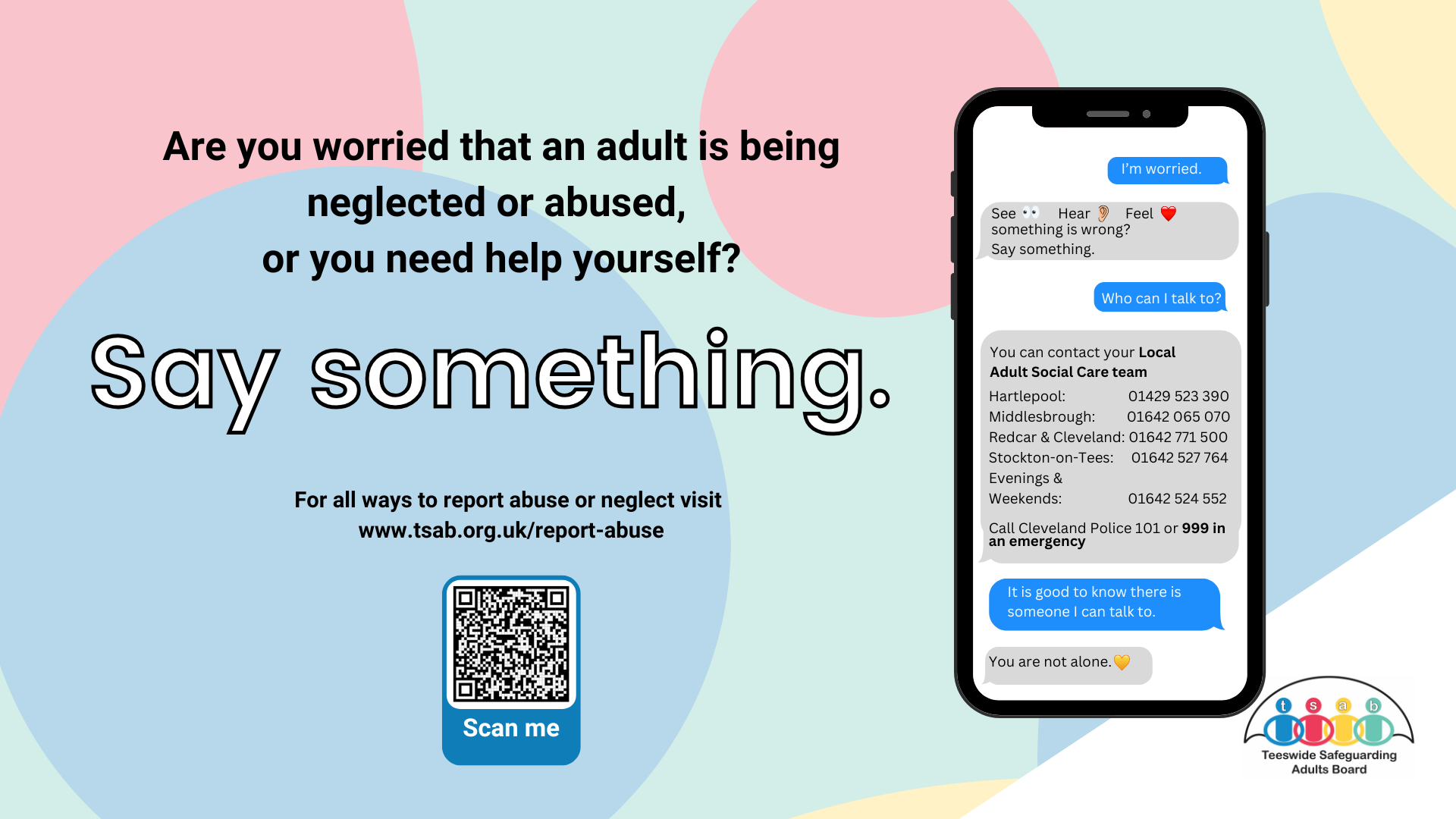
  • Print and display TSAB’s safeguarding poster in offices, community venues, and public spaces.
  • Display the digital poster on digital screens.
  • Follow TSAB on Facebook, LinkedIn and BlueSky, and help spread the message by sharing our social media posts.
  • Let us know how you’ve got involved by emailing [email protected].

Since our last newsletter, TSAB met virtually on 10th June 2026.

Agenda highlights included:

  • LilyAnne’s Wellbeing presented the real life experiences of an individual who accessed their service as part of the TSAB Safe Place Scheme. They discussed the positive impact the scheme had on the individuals immediate safety and access to ongoing support
  • An update on the services provided by Open Door North East, an award winning charity working with refugees and asylum seekers in the Tees Valley area since 2003
  • The approval of the TSAB Strategic Plan 2025-28
  • An update on the High Risk Adult’s Panel review
  • The progress of the Adult Exploitation Strategy
  • An update on the University Hospitals Tees Group model
  • North Tees & Hartlepool NHS Foundation Trust Quality Assurance Framework Assurance Report
  • Sub-group updates
  • TSAB’s attendance and contribution at the National Safeguarding Adults Board Conference
  • DoLS Update: Change in legal test following Supreme Court ruling

A Safeguarding Adults Review (SAR) is a statutory requirement of the Care Act 2014 (Section 44).

The purpose of a SAR is to:

  • Determine what the relevant agencies and individuals involved in the case might have done differently that could have prevented harm or death
  • Learn lessons from the case and apply the learning to future cases to prevent similar harm occurring again
  • Explore examples of good practice where this is likely to inform and improve inter-agency practice.

A SAR is not to hold any individual or organisation to account or to apportion blame.

All recent SARs and related Learning Briefings published by TSAB can be found on the TSAB website.

SARs provide vital learning opportunities for professionals and organisations. We ask that you please review our current Learning Briefings and where appropriate:

  • Managers and supervisors can incorporate the learning into their supervision discussions.
  • Share the learning briefing across your networks.
  • Incorporate the findings into team meeting discussions.
  • Highlight instances where the learning has been applied in updates to the Board.

This month is Recovery Month and we are shining the light on a local Recovery Service operating in Tees.

Recovery Connections is a service supporting people in the North East of England who have experienced drug or alcohol problems, and who want things to be better. They use their lived experience of recovery to help people find their own way forward.

Recovery connections coach people and walk alongside them using there own lived experience to empower others to make positive change at their own pace free from judgement and stigma.

Visit Recovery Connection’s website for more information.

The experiences of people who use services can tell us a great deal about what good professional practice looks like to make services easier for people to engage in. In this case study, a young mother, care leaver and person experiencing ongoing mental health difficulties reflects on the positive difference that a Children’s Social Worker and Recovery Connections Worker made in her life.

Making Every Contact Count – The Real Impact

“A young mother with ongoing mental health difficulties sought support from Recovery Connections and Children’s Social Care after making a self-referral.

She described both her Children’s Social Worker and Recovery Connections Worker as being highly supportive and instrumental in helping her access the right support. Whilst she continued to experience difficulties with mental health services, including challenges accessing appropriate medication and support, both professionals worked hard to bring services together and advocate on her behalf.

The individual stated that her Recovery Connections Worker consistently advocated for her needs, helping her feel valued and ensuring her voice was heard. She described her Children’s Social Worker as kind, non-judgemental and someone who genuinely listened to her concerns.

As a care leaver, she explained that she had often felt disempowered and unheard by services in the past. However, through the support of both professionals, she felt more confident, empowered and able to express her views. She reported feeling listened to, respected and supported throughout their involvement.

Although she was disappointed when her Children’s Social Care case was closed, she recognised the positive impact the support had on her life and acknowledged that others would also benefit from receiving similar support.”

What made these professionals stand out?

  • They listened without judgement.
  • They advocated on her behalf.
  • They worked collaboratively with other services.
  • They empowered her to express her views and have her voice heard.
  • They made her feel valued, respected and supported.
  • They focused on her strengths and goals rather than just her difficulties.

These experiences highlight the power of listening, advocacy, partnership working and person-centred practice in helping individuals feel heard, valued and empowered.

Making Safeguarding Personal (MSP) Guidance

Making Safeguarding Personal (MSP) is an initiative which aims to develop a person-centred and outcomes focus to safeguarding work in supporting people to improve or resolve their circumstances.

MSP is applicable to all agencies working with adults in relation to safeguarding, including those at the initial stages of a Safeguarding Concern being identified. This guidance is designed to provide advice on how best to engage with adults, and work in a committed, multi-agency partnership approach to the subject.

The Cleveland Red Umbrella card is part of the Cleveland Sex Work Strategy which has developed a harm reduction approach to the sex work community across Cleveland. The card might be shown in your service to show the person is a member of this community and to break down barriers to disclosure.

  • The card has a physical version with a QR code on the back and a digital version which can be downloaded to a phone (see below).
  • The card combines the red umbrella, which is the international symbol of sex workers rights and protection from violence, combined with the Tees transporter bridge.
  • This card has two functions:
    • Firstly, those within the sex work community can scan the QR code, or click on the logo if using the digital card, which connects to the Cleveland hub page on the North East Sex Work Forum’s website with details of sex work inclusive services across the region.
    • Secondly, those within the sex work community may show this when accessing services to remove barriers to disclosure leading to more appropriate questions and relevant support.

How to respond if someone shows you the Cleveland Red Umbrella card:

  • This is not for agencies to immediately trigger a safeguarding referral or to immediately think the person wants to leave the industry and needs ‘rescuing’, but to allow for an appropriate response and/or referrals.
  • A response might be “thanks for sharing is this something you would like to discuss today? Is it connected to the incident? Would you like any information about sex work inclusive services, I can direct you to some services?”.
  • Confidentiality is key, but follow your own safeguarding procedures if needed.
  • This is not to be added to a persons’ file as a ‘label’.
  • Some people won’t see themselves as sex workers if they purely work online so the term ‘adult industry’ can also be used and often sparks conversation about what this means.

Please look at the hub page and learn about the services offered and what they offer to the sex work community by connecting to their sites.

The Cleveland Red Umbrella Card (Digital version)
The Cleveland Red Umbrella Card (QR code on the back)

The research paper, Like having 16,000 tabs open in my head: Unravelling the complexity of safeguarding adults at risk of exploitation, draws on interviews with adults with lived experience, practitioners and strategic leaders from a range of sectors. It explores why adult exploitation can remain hidden, how vulnerabilities are targeted by perpetrators, and what conditions are needed for safeguarding systems to respond effectively. The research also highlights the importance of multi-agency working, professional curiosity, understanding coercion and control, and making full use of safeguarding adults processes as a mechanism for protection. 

In this recent blog, the NSPCC is encouraging professionals to use the term ‘non-recent abuse’ rather than ‘historic abuse’ as this language aims to acknowledge the long-term impact of child abuse and reinforce the importance of ongoing support for those who have experienced it.

Key points to take away

  • The terms ‘historic abuse’ or ‘non-recent abuse’ are often used when an adult reports abuse they experienced as a child.
  • When we talk about ‘historic’ abuse, we minimise the impact of abuse and risk reinforcing the idea that once the abuse has stopped the impact on individuals and work of support services is complete.
  • Using trauma-informed language such as ‘non-recent abuse’ supports victims/survivors to speak out and share their experiences.
  • Talking about ‘non-recent abuse’ helps professionals and services to better recognise and provide support for the ongoing impact of child abuse for children, adults and their families.
  • Individuals may choose to use different words to describe their experiences and it’s important that professionals and services are sensitive to this.

Mental Capacity & Safeguarding: Hoarding, Self-Neglect and Refusals of Support

Join colleagues from across the region for this unique opportunity to strengthen practice, improve legal literacy and learn from national safeguarding review findings.

Date: Monday 16 November 2026
Time: 09:30am – 4:00pm
Format: Live online via Zoom

This session will be similar to a previous session held by the Board in December 2025. It is recommended for those who previously did not attend the session or for those who may want a refresher.

About the Session

Some of the most complex safeguarding decisions arise when adults choose to live in circumstances that place them at significant risk. These situations regularly feature in Safeguarding Adults Reviews and often raise challenging questions about autonomy, intervention, risk, and the application of the Mental Capacity Act 2005.

This practical and engaging session will explore:

  • Learning from Safeguarding Adults Reviews and recurring mental capacity themes.
  • Hoarding, self-neglect and refusals of support.
  • Conducting robust and legally defensible mental capacity assessments.
  • Understanding executive functioning and complex decision-making.
  • Capacity and consent within safeguarding processes.
  • Best interests decision-making.
  • The Court of Protection, inherent jurisdiction and available legal powers where significant risks remain.
  • Practical scenarios and case discussions throughout the day.

Who Should Attend?

This event is suitable for practitioners, managers and safeguarding leads working across:

  • Adult Social Care
  • Health Services
  • Mental Health Services
  • Housing
  • Police
  • Fire and Rescue Services
  • Legal Services
  • Community and Voluntary Sector Organisations
  • Safeguarding Adults Boards

and anyone whose role involves safeguarding adults with care and support needs.

About the Speaker

Neil Allen is a nationally recognised expert in mental capacity, mental health and safeguarding law. He is a Barrister at 39 Essex Chambers and has extensive experience in Court of Protection practice. His sessions are widely recognised for combining legal expertise with practical application to frontline safeguarding practice.

We look forward to welcoming colleagues from across the region for what promises to be a thought-provoking and highly valuable learning opportunity.

To book

Request your space now by completing the below form:

Mental Capacity & Safeguarding: Hoarding, Self-Neglect and Refusals of Support.  – Fill in form

Training Courses

To view and request a place on any of our upcoming training courses please visit our Training Courses and Events page.

E-Learning

The Adults & Children Safeguarding Partner Organisations across Hartlepool, Middlesbrough, Redcar and Cleveland and Stockton-on-Tees actively support the ‘Think Family’ approach and are committed to the continuous learning and development of all staff and volunteers working with vulnerable people: adults, children, young people and families.

Through our E-Leaning site you will be able to view, select and be given immediate access to a range of free e-learning opportunities.

#LookCloser Learning Programme: October 2026 to March 2027

Professionals are invited to join The Children’s Society’s #LookCloser Programme of Learning, a free series of online sessions designed to increase awareness and understanding of child exploitation and abuse. Sessions are suitable for professionals across all sectors and levels of experience, offering practical insights, reflection opportunities, and learning that can be shared with teams and networks.

Topics include:

  • Youth Voice: Insights into Education on Exploitation
  • Financial Exploitation
  • Transitions to Adulthood: Preventing Exploitation Around Age 18
  • Anti-Racist Practice and Child Exploitation
  • The Digital Lives of Children and Young People
  • Overcoming Gender Assumptions in Exploitation Work

All sessions are free to attend and delivered via Microsoft Teams Live. Book online via eventbrite.

As part of the HSSCP Trauma Awareness Month campaign that is running throughout October, they are offering a series of free workshops for professionals in Hartlepool and Stockon designed to increase understanding of trauma and support the development of trauma-informed practice.

Working with children, young people and families who have experienced trauma can be both rewarding and challenging. These workshops provide an opportunity to deepen your knowledge of how trauma affects individuals, relationships and behaviour, while exploring practical approaches that can support positive outcomes for those you work with.

Whether you are new to trauma-informed practice or looking to refresh and build upon your existing knowledge, these sessions offer valuable learning for professionals across all sectors working with children and families.

To reserve your free place(s), please click here:

HSSCP – Booking Form – Dashboard | Hartlepool Borough Council – Details

In addition to the local campaigns mentioned previously, listed below are the details of upcoming national awareness campaigns. Further information on our Quarter 2 and 3 campaigns, an be found on our Calendar of Awareness Campaigns 2025-26 webpage.

.

National Safeguarding Adults Week (NSAW) is a time when organisations come together to raise awareness of important safeguarding issues.

We believe that working in partnerships allows us to share our knowledge of safeguarding, learn from others, and work towards creating safer cultures. 

The campaign is led by Ann Craft Trust and the overarching theme this year is “Every Voice. Every Choice“.

During this year’s event, we’ll be collaborating with our partners to explore a different safeguarding theme each day. 

Coming Soon –

In the coming weeks, local activity will be promoted online. Keep a look out on our NSAW webpage for updates, including free webinars hosted by the Ann Craft Trust.

Further Information

Do you have concerns that an adult is experiencing or is at risk of abuse or neglect?

Visit our Report Abuse webpage to find out how to report your concerns. The page hosts the TSAB Concern Form which should be completed and submitted to the relevant local adult social care service or alternatively you can contact them by using the contact numbers listed on the page.

As a reminder you should report abuse when:

  • The adult has needs for care and support (whether or not the authority is meeting any of those needs)
  • And is experiencing, or is at risk of, abuse or neglect

TSAB also have a range of promotional materials to help raise awareness and understanding about abuse and neglect.  

Leaflets and Posters are available which can be displayed within organisations, encouraging people if they are worried someone is at risk to report it. If you are unable to print these, please get in touch and we have a limited number of printed copies.

Are you aware of the Safe Place Scheme?
What is a Safe Place?

  • A place people can go if they don’t feel safe or need some help
  • A place in the community that people know is there in case they need it 
  • This can help them to be more confident to go out independently

Who is a Safe Place for?

Anyone who might be/feel vulnerable, this can include people with:

  • A learning disability
  • Autism
  • A physical disability
  • Dementia                                                                                                    
  • Or someone who is suffering from abuse or neglect.

How can Safe Place help?

Safe Place Scheme venues can provide:

  • A point of contact for anyone who needs it
  • A safe, friendly and welcoming environment where people feel able to ask for help
  • A place where someone can rest if they feel unwell, anxious, upset, afraid or lost
  • A place where people feel listened to
  • Staff who can offer help and advice or help the person call someone they know

Where can you find a Safe Place? There are many locations across Tees. A full list can be found on the Safe Place Scheme webpage.

Please give us a follow and share our profiles with your colleagues to keep up to date with everything Adult Safeguarding in Tees.

Facebook @TeeswideSAB

LinkedIn Teeswide Safeguarding Adults Board TSAB

Bluesky @tsab75.bsky.social

Don’t forget that TSAB has a dedicated webpage hosting details of local and national services.

Can’t see your service/ another service on there and think it should be added? Please send the details to [email protected].

If you have any suggestions for future Newsletters, or any comments, get in touch with us using one of the communication methods below.

Email: [email protected]

Or visit our Website Teeswide Safeguarding Adults Board (tsab.org.uk)

Don’t forget to follow us on social media to stay up to date with the latest resources, updates, and key safeguarding campaigns: